

Pluribus: Out of Many, One
Individual and team performance, and where things go wrong
Hey! It’s Andreas from Monetisation Matters, the home of in-depth articles and actionable insights on Strategy and Monetisation. Built for Founders, and leaders as they navigate their $1m to $100m growth journeys and beyond. This month’s article looks at the foundations of performance for individuals and teams, and where things go wrong.

Pluribus
The most miserable woman on Earth must save humanity from a virus. Not a virus with the effects one might expect. People don’t get ill or violent. They become connected, peaceful, and completely aligned around a single goal – to spread the virus that brings them together. This is the basic plot of Breaking Bad Creator’s new show Pluribus.
Individuals form a team of billions. The team has perfect cohesion, motivated by the same goal. Each individual can access the skills, technical knowledge and memories of the group. It is the perfect team. They have transcended the limits of a person-bit — a single individual can do more — but as a group they can achieve almost anything: out of many they become one.
It has to start with the individual
Individuals form teams. Teams collaborate with other teams to form organisations. And organisations collaborate, compete and interact. So the performance of individuals has to be the starting point for performance of any group.
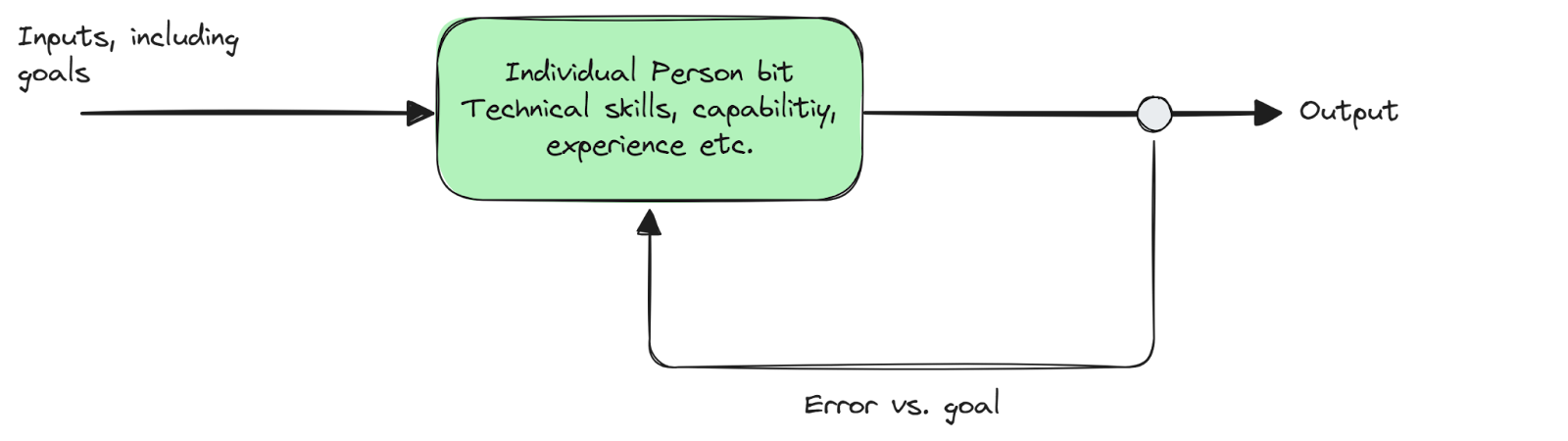
I’m not trying to reduce people down to soulless machines, but it’s helpful to think in terms of the mechanics of an individual as a goal seeking machine to uncover what can go wrong with that system:
An individual comes with certain technical skills and experience
He/she sets or is given a goal
He/she moves both subconsciously and consciously towards that goal
And measures progress towards the goal, feeding back errors (mistakes)
This has two effects: i) improves capability through learning; ii) allows course correction
Even this simple model helps to illuminate where dysfunction can come from at the level of an individual:
The technical skills and experience is completely unmatched to the challenge posed by the environment, so the individual is overwhelmed, cannot progress or learn. This is where the vast majority of attention is usually spent: do we think someone is sufficiently up to the job?
An inaccurate assessment of one’s capability vs. the challenge. This is what Patrick Lencione means when he talks about being humble. And it cuts both ways: thinking you are useless is just as damaging as overconfidence, not least because we act outwardly in a way that is consistent with our beliefs and emotions — so believing yourself to be incapable will make it so.
Unclear goals or the wrong goals. People will move towards the goals they consciously or subconsciously set. This is why it’s so fundamental to set and clarify goals even for capable people, or maybe especially for capable people — the problem with setting someone capable the wrong goals is that they will achieve them.
Progress can be slow and frustrating because of lags between action and effect. The gap between where someone is and where they want to get to generates tension which propels them forward. But we aren’t machines, so as we make that comparison we also experience emotional tension pulling us back, encouraging us to reduce the ambition of our goals. Performance depends on positive tension dominating negative emotional tension, so that you keep driving through adversity and don’t progressively roll back your ambition.
The inability to learn from mistakes. Mistakes are inevitable, they are a feature not a bug. It fuels the adjustments needed to keep making progress. So learning has to sit at the heart of performance. There is a challenge here though as it’s not always clear what was a mistake, not least because of complexity and lags between cause and effect. We aren’t always sure of what the lesson is.
Agonising over mistakes and not focusing on the goal. High performers learn from past mistakes but they don’t agonise over them. Similar to having an insufficient self image, if one focuses on what has gone wrong previously, it’s more likely to be repeated.
From individuals to teams
The requirements we covered above are just as applicable to teams as they are to individuals:
The team needs the right mix of technical skills and experience to face the combined challenge
An accurate assessment of where there are gaps and weaknesses, especially as the nature of the challenge evolves
Clear goals for the team as a whole to drive cohesive action
Maintaining the creative tension of the team to persevere
The ability to learn from mistakes, share learnings, and to maintain learnings in the team as people leave
On top of that, there are additional requirements for the group as complexity increases:
A clear purpose for the team as a whole
Clear roles within the team
Coordination mechanisms, rituals and habits
Clear expectations and accountability for results
A high level of trust between individuals
Structures and ways of working that promotes wholeness:
Everything is ‘on the table’ and can be discussed
Dialogue and the suspension of positions and willingness to test assumptions
Tolerance for healthy conflict
Many of these requirements address the need for cohesive action, whilst letting people get on with their jobs and make decisions i.e. balancing the need to act as one whilst providing people with autonomy.
To avoid repeating the sources of dysfunction above, they are all still applicable, but now apply both to individuals and the group. So where does additional dysnfunction creep in at the level of a team?
Dysfunction can start from something as fundamental as identity and purpose. Why does the team exist? Does it even feel like a team, or a loose collection of individuals?
There’s the basics of everyone knowing what they need to know to sequence and coordinate activities. As an individual it’s straightforward to sequence tasks and understand where the dependencies are. It gets more complicated where projects depend on progress in multiple parts of the org.
It can be uncomfortable to hold peers to account so it happens less than it should. Sometimes it’s the result of the things that are left unsaid when making a decision – buy-in that never existed, or a lack of clarity over what decisions were made and where accountability sits.
If individuals on a team don’t trust each other – in the sense that they are all there to act in good faith, in a way that is aligned to the team’s purpose, then I don’t see how they could ever be performant. Without it you don’t get healthy conflict, commitment, accountability or results.
The Table Group talks a lot about how a lack of healthy conflict is the sign of a toxic culture. I think they rely on that so heavily because it’s a shortcut for knowing that members of a team are being open and honest, and that everyone is contributing. This is a fine heuristic but I’m not convinced that we should be optimising for conflict, it’s just a forcing function to talk openly and then get to a committed decision.
I’ll end this short essay with a quote. Pluribus wasn’t inspired by but does have similarities with the philosophy of Physicist David Bohm’s work on ‘Wholeness’. If we expand the boundary of our identities to include our team members, we are already setting the conditions for a better performing whole.
“Everybody depends on everybody, but actually everybody is everybody”.
David Bohm
I enjoy writing, but it is a tremendous investment. If you enjoyed this article, please consider sharing it with your colleagues and friends so that it may grow.
Thank you.
This is a useful way to think about how individual performance scales into team performance